
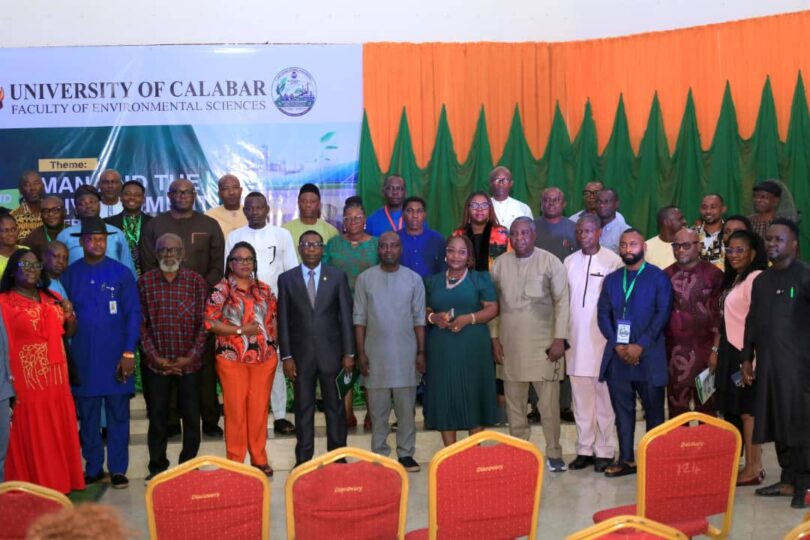

The Vice-Chancellor of the University of Calabar (UNICAL), Prof. Offiong Efanga Offiong, has called on stakeholders to take deliberate action towards protecting the environment and promoting sustainable development.
He made the call during the 2nd International Conference of the Faculty of Environmental Sciences, held at the Cross River Community Hall of the university, with the theme, “Man and the Environment: Interactions, Impacts and Pathways to Sustainability.”
Represented by the Deputy Vice-Chancellor, Research, Linkages and Collaboration, Prof. Anthony Egrinya Eneji, the Vice-Chancellor stressed that the environment is fundamental to human survival and development, urging individuals, institutions and policymakers to prioritise its protection.
He encouraged participants to make meaningful use of the conference by sharing knowledge, building partnerships and developing practical solutions to environmental challenges.
Prof. Offiong also commended the Faculty of Environmental Sciences for organising what he described as a timely and academically significant conference, expressing confidence that its resolutions would contribute to efforts to safeguard the environment.
He further praised the quality of contributions from the panellists, noting that their discussions offered valuable insights into the environmental challenges facing society and possible ways of addressing them.
Earlier, the Dean of the Faculty of Environmental Sciences, Prof. Francis I. Okpiliya, described the conference as particularly important given the growing environmental challenges confronting humanity.
He identified climate change, pollution, biodiversity loss, rapid urbanisation, resource depletion and environmental health concerns as major issues requiring urgent attention.
According to him, addressing these challenges demands interdisciplinary knowledge, innovative thinking, effective governance and collective action to develop sustainable solutions suited to local realities.
He described the conference as a platform for exchanging knowledge, presenting research findings, encouraging critical discussions and strengthening collaboration among universities, industries, government agencies, civil society organisations and other stakeholders.
Similarly, the Chairperson of the Local Organising Committee, Prof. Elizabeth E. Andrew-Essien, emphasised the importance of interdisciplinary collaboration in understanding the relationship between human activities and the natural systems that sustain life.
She noted that the conference provided an opportunity for scholars, practitioners, policymakers and students to examine how human systems interact with the environment and explore ways to address emerging challenges.
Prof. Andrew-Essien explained that the conference covered several sub-themes, including environmental governance, land and water ecosystems, the built environment, health, energy, pollution, climate and environmental economics, digital innovation and creative arts.
She urged participants to remain open to cross-disciplinary discussions, stressing that the complexity of environmental issues requires experts from different fields to share ideas and learn from one another.
The committee chairperson expressed optimism that the conference would produce fresh research, practical knowledge and meaningful recommendations capable of supporting a sustainable future for Cross River State, Nigeria and the wider world.
The conference featured panel discussions, scholarly presentations and interactive sessions designed to strengthen environmental knowledge, improve policy and practice, and promote sustainable development.
ALSO READ:UNICAL VC Reveals What Teachers Must Do to Restore Trust in Education
Hope you find the Above publication useful, Calabargist will love to keep you updated via our newsletter by subscribing with your email.