
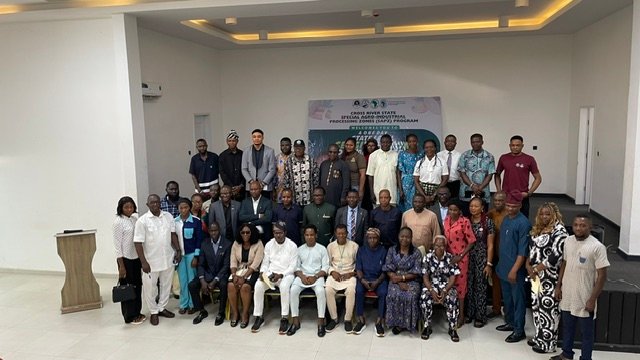

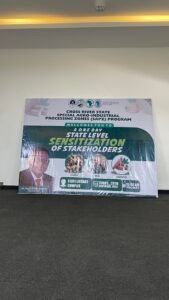
The Cross River State Government has intensified efforts to advance its participation in the Special Agro-Industrial Processing Zones (SAPZ) Programme, with a one-day state-level stakeholder sensitisation meeting highlighting ongoing infrastructure development, farmer support, investment opportunities and plans to strengthen the state’s agricultural value chains.
The programme focuses on cassava, rice and cocoa production, with the broader objective of connecting farmers to processors, markets and investment opportunities while promoting inclusive agro-industrial development.
Speaking at the meeting, the State Project Coordinator, Akwa Oko, appreciated participants and outlined steps taken by Governor Bassey Edet Otu’s administration to secure Cross River State’s participation in the programme.
He explained that the initiative is designed to support agricultural production and processing, ensuring that the benefits extend from the farm to the final consumer.
AfDB Support and SAPZ Funding Structure
During the programme overview, the SAPZ Monitoring and Evaluation Officer, Dr. Felix Eke, explained the programme’s operational structure, funding arrangements and implementation status in Cross River State.
He disclosed that the programme is supported by the African Development Bank (AfDB), with the presentation highlighting over $1.96 million in counterpart funding by the state.
Dr. Eke explained that SAPZ is not a political programme but an agricultural development initiative. He said farmer profiling and data collection are being conducted across local government areas and communities that produce the selected value-chain commodities.
According to him, more than 5,000 farmers have been sensitised, while the programme is profiling farmers across communities, with a maximum target of 4,000 farmers per local government area.
He noted that cassava, rice and cocoa were selected because of their agricultural production potential across participating states.
SAPZ Targets 100,000 Farmers and Over 3,000 Jobs
The presentation outlined several expected benefits of the programme for Cross River State, including:
- Supporting the livelihoods of up to 100,000 farmers.
- Creating more than 3,000 employment opportunities.
- Improving agricultural productivity and farmers’ incomes.
- Reducing food importation, particularly rice imports, through increased local production.
- Providing training in digital agribusiness management.
- Developing agribusiness micro, small and medium enterprise (MSME) clusters for primary processing.
- Strengthening agricultural production, processing and market access.
The initiative is also expected to encourage local value addition, reduce post-harvest losses and attract private-sector investment into the agricultural sector.
Implementation Status and Infrastructure Development
The SAPZ presentation identified two major project locations in Cross River State: the Agro-Industrial Hub (AIH) at Adiabo and the Agricultural Transformation Centre (ATC) serving the Ogoja/Yala axis.
The State Project Implementation Unit reported that infrastructure works covering 130 hectares at the Agro-Industrial Hub and 30 hectares at the Agricultural Transformation Centre were approximately 30 per cent completed.
The proposed infrastructure includes administrative buildings, perimeter fencing, laboratories, internal roads and parks.
Other implementation milestones highlighted at the meeting include:
- Training of more than 1,000 farmers to improve agricultural productivity.
- Completion and national-level validation of the draft Cross River State SAPZ Policy document.
- Establishment of the State Project Implementation Unit with relevant technical officers.
The meeting also outlined the next steps required to advance the infrastructure and other components of the programme.
Adiabo and Ogoja/Yala to Anchor Agro-Industrial Activities
Presenting on infrastructure development, the SAPZ State Infrastructure Engineering Officer, Engr. Dr. Enang Egbe, explained that the programme seeks to build a competitive agro-industrial ecosystem connecting agricultural producers with processors, markets and investors.
He identified Adiabo as the proposed location of the Agro-Industrial Hub, which will serve as the industrial processing anchor.
Its potential functions include large-scale processing and manufacturing, bulk aggregation, storage, distribution, shared utilities and industrial services.
The Agricultural Transformation Centre in Ogoja/Yala is designed to bring services closer to farmers and production communities. Its proposed functions include farmer support, agricultural inputs and extension services, produce collection, sorting, grading, primary processing and temporary storage.
Under the proposed delivery structure, farming communities will supply produce to the Agricultural Transformation Centre for collection and preparation before movement to the Adiabo Agro-Industrial Hub for processing and value addition. The finished products will then be connected to domestic and export markets.
Cocoa, Rice and Cassava Identified as Priority Value Chains
The SAPZ programme will concentrate on three priority agricultural commodities: cocoa, rice and cassava.
For cocoa, the proposed interventions include farmer production and aggregation, fermentation, drying, grading, quality control, traceability and processing.
For cassava, the programme will support improved planting materials, production, collection, sorting and primary handling, as well as the production of flour, starch and other value-added products.
For rice, the interventions will cover farmer support, paddy aggregation, drying, cleaning, milling, grading, packaging and distribution.
Investment Opportunities for Private Sector Operators
The infrastructure and value-chain components of SAPZ are expected to create opportunities for private investors and agribusiness operators.
The presentation identified investment opportunities in processing, packaging, storage, cold-chain facilities, agricultural inputs, logistics and equipment.
Potential investors can participate through different arrangements, including direct private investment, public-private partnerships, facility leasing, concessions, outgrower arrangements, joint ventures and service contracts.
The programme also highlighted enabling infrastructure such as access roads, power supply, water and drainage systems, processing facilities, warehouses, laboratories and shared-use spaces.
It identified access to agricultural produce and farmer networks, opportunities in growing food markets, product diversification, employment and skills development as potential investor benefits.
The presentation also addressed practical risks, including raw-material supply, energy costs, logistics and regulatory compliance, with proposed responses such as outgrower schemes, production planning, backup energy systems, coordinated transportation and clear operating agreements.
SAPZ Seeks to Improve Farmers’ Productivity
The SAPZ Agriculture Productivity Officer, Dr. Bethel Ewung, spoke on strategies to improve farmers’ productivity and position Cross River agricultural products for domestic and international markets.
He highlighted the programme’s focus on sustainable agro-industrial development, inclusive economic growth and stronger connections among agriculture, industry and commerce.
The presentation identified existing and targeted productivity levels for the selected value chains as follows:
| Commodity | Current Productivity | Target Productivity |
|---|---|---|
| Cocoa | 400–500 kg/ha | 1,500–2,000 kg/ha |
| Rice | 2–3 tonnes/ha | 5–10 tonnes/ha |
| Cassava | 6–10 tonnes/ha | Above 10 tonnes/ha |
To support these targets, the programme outlined plans for training agricultural extension agents across the public and private sectors, alongside farmer training across the three value chains.
The presentation also referenced training for 560 farmers, strategic partnerships with the Cocoa Research Institute of Nigeria (CRIN) and AfricaRice, and input support, including 500,000 cocoa seedlings, agrochemicals and post-harvest equipment.
Dr. Ewung called on stakeholders to support sensitisation, value addition, traceability, monitoring and evaluation, policy advocacy and compliance with safeguards. He added that prospective farmers seeking to participate in the programme must first be profiled.
Gender Inclusion and Value Addition
The SAPZ Gender and Social Safeguard Officer, Dr. Gloria Ogban, addressed opportunities for farmers and other stakeholders to improve their livelihoods through value addition.
She explained that value addition involves activities and investments that help farmers, cooperatives and processors preserve product quality, transform agricultural produce, access better markets and improve their earnings.
The areas highlighted include post-harvest handling, processing and transformation, storage and logistics, packaging, branding and labelling, quality control, food safety and market development.
The presentation emphasised three key elements of the SAPZ structure: preserving value, transforming value and capturing value.
These interventions are expected to help cocoa, cassava and rice producers move beyond the sale of raw produce towards higher-value products with improved market opportunities.
Stakeholders Urged to Support Programme Implementation
The stakeholder sensitisation meeting provided an opportunity to explain the objectives, implementation structure, infrastructure plans and investment opportunities under the Special Agro-Industrial Processing Zones Programme in Cross River State.
With the proposed Agro-Industrial Hub at Adiabo and Agricultural Transformation Centre in Ogoja/Yala, the programme seeks to strengthen the connection between farming communities, processors and markets.
The success of the initiative will depend on effective collaboration among government institutions, farmers, investors, agricultural organisations, community stakeholders and other partners.
Through improved productivity, infrastructure, processing capacity and market access, SAPZ is expected to contribute to agricultural development, employment generation and improved livelihoods across Cross River State.
Hope you find the Above publication useful, Calabargist will love to keep you updated via our newsletter by subscribing with your email.