
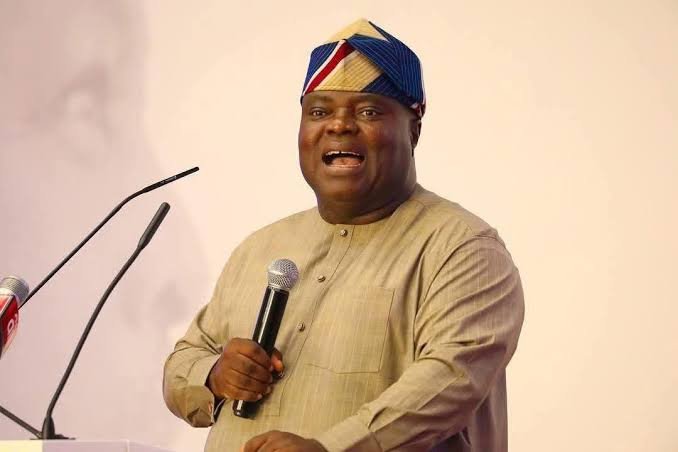

Sandy Onor: When Criticism Becomes an Exercise in Confusion
By Ojong Ogar-Bisong
There is something profoundly unsettling about Sandy Onor’s latest political intervention in Cross River State. It is not necessarily the audacity of his criticism of Governor Bassey Otu that is troubling; in a democracy, criticism is indispensable, opposition is legitimate, and accountability must never be treated as an act of hostility. What is, however, difficult to reconcile is the extraordinary contradiction between his professed commitment to Cross River’s destiny and the political proposition he is vigorously marketing. In one breath, he assumes the posture of a champion of Cross River’s emancipation awaiting a coronation as president in 2027; in another, he openly advertises the Rainbow Coalition of his political principal, Nyesom Wike, as a vehicle for returning President Bola Tinubu to power. Yet, remarkably, he would have his followers believe that his own presidential ambition holds the magic wand for resolving Cross River’s developmental challenges. What an astonishing exhibition of political doublespeak!
One thing, however, stood out at the Ikom rally of his factional Peoples Democratic Party, PDP. It was a case of a character afflicted by Dissociative Personality Disorder. Call it split Personality, if you like. His rhetoric could barely veil the depth of his confusion. Frustration equally stood out in bold relief. Frustration from unrealized ambition. Uncertainty about his already 2031 stymied ambition. The difficulty in marketing a governorship candidate he rejected back then as his running mate in 2023, over sundry integrity and credibility deficiency syndrome. All that played out at Ikom.
A presidential candidate whose campaign appears so conspicuously confined to Cross River must first explain how he intends to construct a national mandate from a geographically restricted political conversation. Does he seriously imagine that Nigeria’s presidency is won with votes from one state? Or is his presidential ambition merely an elaborate theatrical prop in a local political drama?
More troubling is the apparent contradiction between his denunciation of Governor Otu’s relationship with neighbouring states and his own enthusiastic embrace of a political arrangement that places Cross River’s interests within the orbit of external political power. His prescription for Cross River’s oil-producing status is diplomacy with Akwa Ibom, which, in itself, is not objectionable. Indeed, constructive engagement between sister states is desirable. But diplomacy must never become an invitation to political subordination, nor should the legitimate interests of Cross River be sacrificed on the altar of another man’s political calculations. Cross River is neither a political appendage nor a disposable bargaining chip in anybody’s coalition arithmetic. Its dignity, sovereignty and economic interests are not negotiable. Onor must therefore reconcile his professed defence of Cross River with the political alliances he is so enthusiastically promoting. Until then, his self-appointed guardianship of the state’s destiny will remain burdened by a credibility deficit.
His central argument that Governor Otu’s administration has performed poorly because it has not commissioned enough projects is equally pedestrian and intellectually disingenuous. Since when did governance become synonymous with ribbon-cutting ceremonies? Since when did the absence of a commissioning photograph constitute proof that a project does not exist? A completed road does not become imaginary because a governor has not assembled dignitaries to cut a ceremonial ribbon. Infrastructure is built for public use, not for the photographic gratification of politicians.
By Onor’s peculiar arithmetic, perhaps Cross Riverians should stop using roads constructed across the state until the governor formally commissions them. Perhaps the security enjoyed by communities should be suspended until a ceremonial inauguration is performed. Perhaps retirees should disregard the ₦10 billion paid in gratuities because no ribbon was cut over the transaction. And perhaps the approximately ₦70 billion deployed towards debt servicing should be treated as non-existent until the governor commissions the repayment. Such reasoning is not political sophistication; it is a spectacular reduction of governance to ceremonial choreography.
Equally curious is his attempt to appropriate the campaign practices of previous administrations as an immutable performance template. Donald Duke and Liyel Imoke deserve recognition for their respective contributions to Cross River’s development, but their legacies should not become instruments for discrediting every administration that succeeds them. Governance is not a competition in the frequency of project commissioning ceremonies. It is a continuous process involving infrastructure, financial obligations, institutional reforms, security, economic recovery and the painstaking correction of inherited structural deficiencies. Governor Otu’s determination to confront historical injustices, particularly Cross River’s oil-producing status, deserves objective assessment rather than cynical dismissal. Indeed, the very struggle Onor acknowledges as requiring diplomatic engagement underscores the importance of sustained institutional commitment beyond political theatrics.
Senator Onor is entitled to his opinions, but he is not entitled to monopolise the definition of Cross River’s progress. His criticism would command greater respect if it were accompanied by intellectual consistency, verifiable evidence and an honest appreciation of the complexities of governance. Cross River needs constructive opposition, not political grandstanding; rigorous scrutiny, not rhetorical acrobatics; and statesmanship, not a travelling theatre of contradictions. Governor Otu should be judged by measurable outcomes, not the volume of applause at commissioning ceremonies. A self-style presidential candidate, Sandy Onor should understand that the people of Cross River are discerning enough to distinguish genuine accountability from the calculated desperation of a politician seeking relevance. The destiny of Cross River is too precious to be reduced to anybody’s political ambition, coalition propaganda or presidential daydream.
Ogar-Bisong is a Cocoa farmer resident in Etung
Hope you find the Above publication useful, Calabargist will love to keep you updated via our newsletter by subscribing with your email.