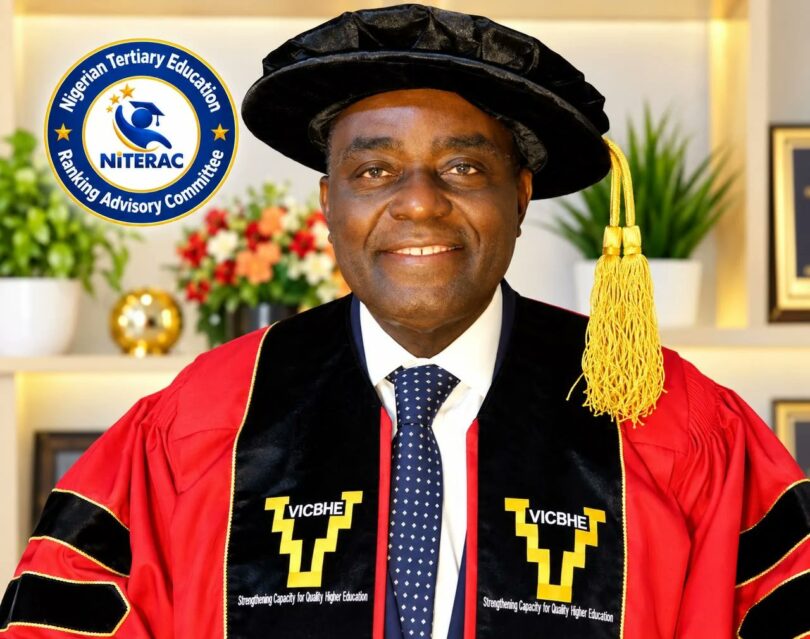

The Chairman of the Nigerian Tertiary Education Ranking Advisory Committee (NiTERAC), Prof. Peter Okebukola, has called on Nigerian universities to improve their academic reputation, research output and international collaborations to strengthen the country’s position in global university rankings.
Okebukola made the call while assessing Nigeria’s performance in the 2027 Times Higher Education (THE) World University Rankings, released on Wednesday, September 30, 2026.
The latest rankings assessed 2,297 universities across 118 countries and territories, with Nigeria recording 29 ranked institutions, an increase from 24 in the 2026 edition. This also made Nigeria the most represented country in sub-Saharan Africa, where 69 universities featured in the rankings.
Despite the increase in representation, Okebukola stressed that Nigerian universities must address persistent weaknesses in key performance indicators to achieve better positions internationally.
He identified global academic reputation as a major factor requiring attention, noting that reputation-related measures account for 33 per cent of the overall ranking score.
According to him, Nigerian institutions can strengthen their international standing by participating more actively in global academic conferences, conducting joint research, attracting visiting professors and building stronger relationships with academics and alumni in the diaspora.
The former Executive Secretary of the National Universities Commission (NUC) also highlighted the need for increased research funding, improved publication productivity, accurate institutional data submission, higher doctoral output and stronger engagement with industries.
His assessment showed that research quality was Nigeria’s strongest performance area, with a mean score of 43.3, while research environment and teaching recorded mean scores of 13.9 and 20.6, respectively.
In the 2027 rankings, the University of Ibadan, University of Lagos and Covenant University jointly occupied Nigeria’s highest position, placing in the global 801–1,000 band.
Four other institutions — Ahmadu Bello University, Bayero University, Landmark University and the University of Ilorin — featured in the 1,001–1,200 band, bringing the number of Nigerian universities in the global top 1,200 to seven.
Beyond the 29 ranked universities, another 32 Nigerian institutions were listed in the Reporter category, having submitted data but not met all the requirements for inclusion in the ranked table.
Okebukola described the results as a diagnostic tool for the country’s higher education system, providing evidence to guide reforms and identify areas requiring improvement.
He further disclosed that NiTERAC had commenced work on a national ranking of Nigerian universities, polytechnics and colleges of education following a directive from the Minister of Education, Dr. Tunji Alausa.
The exercise, which will assess universities using 22 indicators, is expected to be completed before December 15, 2026, and is aimed at encouraging healthy competition among tertiary institutions while improving Nigeria’s performance in future global rankings.
The development highlights ongoing efforts to strengthen the country’s tertiary education system through improved academic standards, research investment and international engagement.
ALSO READ:UNICAL, ICAN Explore New Ways to Strengthen University Development
Hope you find the Above publication useful, Calabargist will love to keep you updated via our newsletter by subscribing with your email.