

There are children who go to school carrying books in their hands and burdens in their hearts.
They sit quietly in classrooms, listening to lessons while, somewhere in the back of their minds, there is a question they are too young to ask aloud: Will I still be here next term?
They dream of becoming doctors, teachers, engineers, lawyers, scientists and other professionals. They dream with the innocence of children who do not yet understand how expensive dreams can become.
For some of them, however, poverty can stand between ambition and opportunity.
Parents may find themselves choosing between school fees and food, transport and rent, or keeping a child in school and meeting another urgent household need. The challenge is often not a lack of intelligence or ambition, but the financial circumstances surrounding the child.
It is against this backdrop that Rep. Bassey Akiba’s Educational Support Programme has positioned education as a major area of intervention for constituents in Calabar Municipality/Odukpani Federal Constituency.
From ₦50 Million to ₦150 Million
The programme has expanded across successive academic sessions.
The first edition, launched in 2024, was valued at ₦50 million and targeted students in public primary, secondary and tertiary institutions within the constituency.
The second phase, launched in 2025, was increased to ₦100 million, with educational support extended to more beneficiaries. Reporting on the programme noted that more than 2,000 constituents had benefited from scholarships and other educational interventions under its education component within the first two years of the initiative.
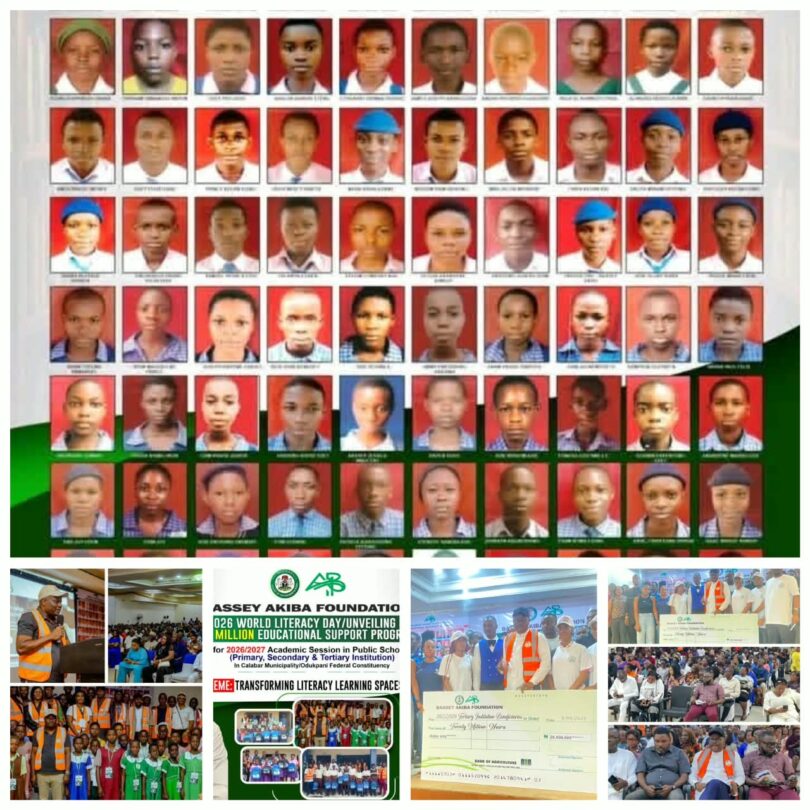
The third edition, according to the programme information provided, has now been unveiled at ₦150 million for the 2026/2027 academic session, covering public primary, secondary and tertiary institutions within Calabar Municipality/Odukpani Federal Constituency.
The progression from ₦50 million to ₦100 million and now ₦150 million represents an expansion in the financial size of the programme.
But behind those figures are individual students and families for whom educational assistance can mean the difference between continuing their studies and facing an interruption.
More Than Financial Assistance
Educational support is not simply about paying a bill.
For a student struggling to meet school fees, examination fees or the cost of learning materials, assistance can remove one of the barriers standing between the student and the classroom.
Previous editions of the programme have included support such as school fees, examination fees, textbooks, exercise books and school bags. A 2026 intervention at Federal Government Girls College, Calabar, for example, included more than 2,000 students, over 2,500 textbooks, 120 school bags and payment of tuition and examination-related fees for more than 120 students in examination classes.
Such interventions can provide immediate relief to families facing the rising cost of education.
“A Child of Nobody Can Become Somebody”
The idea behind the programme can be captured in a simple but powerful expression:
A child of nobody can become somebody without knowing anybody.
For many young people, educational opportunities should not depend on family connections, influential surnames or access to powerful individuals.
A child should be able to dream, work hard and have a reasonable opportunity to pursue that dream.
That principle is particularly significant for students from ordinary homes, where parents may have limited resources but their children possess the ambition and ability to succeed.
A student who receives support at the right moment may not remember the exact amount involved years later. But that student may remember that someone helped keep the educational journey going when circumstances threatened to interrupt it.
Giving Families Room to Breathe
For parents, educational expenses can create significant pressure.
There may be school fees to pay, books to purchase, examination charges to meet, transportation costs and other household responsibilities competing for the same limited income.
When assistance comes at such a point, it can ease some of that pressure.
The impact therefore extends beyond the beneficiary. It can also reach parents and guardians who are trying to keep their children in school despite financial difficulties.
Building a Continuing Education Intervention
Rep. Akiba has previously described education as one of the central areas of his constituency interventions.
In 2025, he said his constituency interventions were structured around livelihood, health and education, and disclosed that education was receiving a significant share of the available constituency intervention resources.
The educational support programme has consequently developed as a continuing intervention rather than a single academic-year initiative.
The expansion across three editions also provides a basis for measuring how the programme grows in reach, beneficiaries and educational support over time.
The Human Story Behind the Numbers
There may be a student somewhere today who is carrying a dream much bigger than the circumstances surrounding them.
A future doctor.
A future professor.
A future engineer.
A future scientist.
A future lawyer.
A future teacher.
A future leader.
That student may not yet know how far the journey will go.
But when education is sustained at a critical moment, the possibility of that future remains open.
This is where educational intervention acquires its deepest human meaning. It is not only about the money spent; it is about the opportunity that remains available because a financial barrier was removed.
Representation Beyond the Legislature
For elected representatives, the relationship with constituents extends beyond legislative activities.
Constituency interventions are one way elected officials seek to respond to needs identified within their communities. Rep. Akiba has described his approach as a constituency-based initiative covering areas including education, healthcare, agriculture, infrastructure and economic empowerment.
The Educational Support Programme places young people and access to education at the centre of one aspect of that intervention.
Ultimately, the real measure of any educational support programme lies in what happens after the assistance: students remaining in school, completing their education and using the opportunities created to build better futures for themselves and their communities.
For the beneficiaries of the 2026/2027 edition, the hope is simple: that a school bill will not become the reason a promising child stops dreaming.
And perhaps years from now, somewhere far beyond the classrooms of today, one of those beneficiaries will look back and remember the moment education was almost interrupted — and the moment support arrived.
A child of nobody became somebody, without knowing anybody.
Hope you find the Above publication useful, Calabargist will love to keep you updated via our newsletter by subscribing with your email.