
How SAMAC Is Building a New Generation of Musicians in Lagos
When Imọlẹayọ Balogun started teaching music in a single room in Lagos in 2007, the ambition was straightforward: help students learn the saxophone properly and prepare them for recognised music examinations.
More than a decade later, that small beginning has grown into the Saxophone Music Academy, known as SAMAC, a registered music institution in Egbeda, Lagos, where students can study everything from saxophone and violin to piano, drums, traditional African instruments, music theory and jazz improvisation.
The change reflects a broader ambition that has shaped the academy over the years. SAMAC is not built around learning an instrument alone. Its programme is designed to introduce students to the wider discipline of music, combining practical performance with theory, composition, harmony, research and African music studies.
Balogun’s original focus was the saxophone. He taught technique and jazz improvisation while preparing students for the theory and practical examinations of the Associated Board of the Royal Schools of Music (ABRSM), Trinity College of Music and the Musical Society of Nigeria (MUSON).
As demand grew, the school evolved.
In 2009, SAMAC moved into its own centre on Kareem Laka Street, Egbeda Akowonjo, giving the institution a permanent base from which to expand its programmes.
Today, the academy’s curriculum reaches across the major families of orchestral instruments. Students can study violin, viola, cello and double bass under strings; trumpet and trombone under brass; and clarinet, flute, oboe and saxophone under woodwind.
Piano and drums form part of its percussion and keys programme, while the curriculum also makes space for instruments associated with Nigerian musical traditions, including the Ọjá, an Igbo flute, and the Gángan, the Yoruba talking drum.
That combination of Western classical training and African musical traditions is one of the more distinctive elements of the school’s approach.
Music education at SAMAC extends beyond performance. Students are introduced to chordal progression and reharmonization, composition and arranging, jazz studies and improvisation, writing and music research, as well as African music studies.
The academy has structured its programmes into two main routes.
The Basic School takes students from Grade 1 through Grade 8, with each grade lasting 12 weeks and carrying its own certificate. It is designed to allow students to enter at different points and progress through their training as they complete each stage.
The Diploma School offers a more intensive programme spread across two semesters. Students major in one instrument, take a second as a minor and select either classical or contemporary/jazz studies.
Admission to the diploma programme requires Grade 5 theory and practical proficiency. The course combines instrumental development with harmony, composition, arranging, jazz improvisation, research and other areas of musicianship.
For students who want to continue their education beyond SAMAC, the academy also assists Diploma graduates seeking Direct Entry admission into a Bachelor of Arts in Music programme.
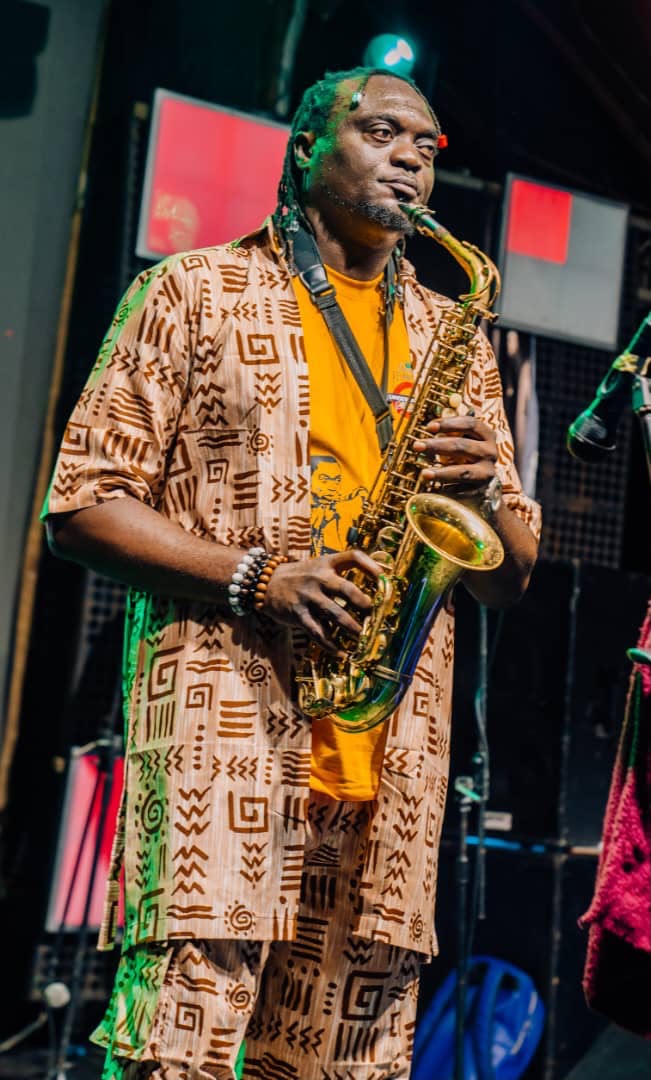
Much of this academic direction comes from Balogun himself, whose career has developed alongside the institution.
A saxophonist, educator and researcher, Balogun studied contemporary music at Peter King College of Music in Badagry before attending the MUSON Diploma School for classical music. He subsequently earned bachelor’s and master’s degrees in Music from the University of Lagos and was pursuing a Ph.D. at the time of this profile.
His career has also taken him beyond the classroom. He has performed at jazz festivals in Nigeria and internationally, including in the United States, Kenya and Ghana, and has shared stages with jazz musicians from different parts of the world.
His teaching experience includes the MUSON Diploma Department, where he has taught saxophone major and minor and clarinet minor since 2010 and directs the school band.
He has also served as Principal at Peter King College of Music, teaching saxophone technique and leading workshops that cover jazz, highlife, salsa, reggae, traditional music and choral performance.
At SAMAC, those experiences come together in his role as Director of Studies. His teaching responsibilities span music theory, Western harmony, saxophone, flute, clarinet, jazz studies and improvisation, band culture and research.
The result is an academy that sits somewhere between a conventional music school and a broader musicianship programme.
A student may enter through a single instrument, but the training does not have to stop there. As students progress, they are exposed to the theoretical, creative and cultural dimensions of music that can influence how they eventually perform, compose, arrange or teach.
That model also reflects the changing possibilities available to musicians. Technical ability remains fundamental, but musicians increasingly operate across several areas, from live performance and recording to composition, teaching, arranging and music research.
SAMAC’s development from a one-room school in 2007 to a registered academy offering graded and diploma-level programmes has therefore been less about expanding the number of instruments on its timetable and more about broadening what it means to study music.
At its centre in Egbeda, the original idea remains visible: give students a structured path into music, build their abilities progressively and expose them to enough of the discipline to discover where their own musical ambitions may lead.
For an academy that started with saxophone lessons in a single room, that has become a considerably larger undertaking.
Hope you find the Above publication useful, Calabargist will love to keep you updated via our newsletter by subscribing with your email.