
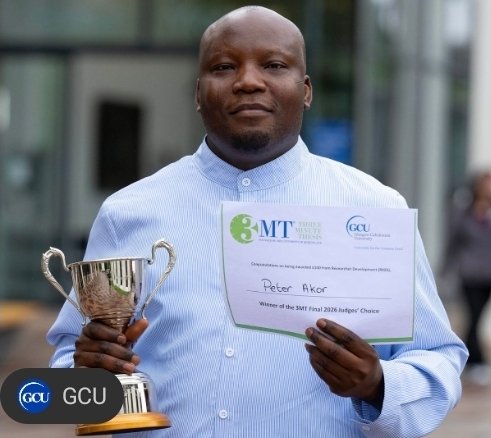

A Nigerian researcher, Peter Akor, has achieved international recognition after winning two major awards at the 2026 Vitae Three Minute Thesis (3MT) national competition in the United Kingdom.
Akor, a postgraduate researcher at Glasgow Caledonian University in Scotland, won both the Judges’ Choice Award and the People’s Choice Award for his presentation on technology that could help predict epileptic seizures before they occur.
His research presentation, titled “The Minutes That Matter: Transforming Epileptic Seizure Care from Reaction to Prediction,” explored how technology and data could be used to provide early warnings of seizures, potentially improving patient safety and quality of life.
According to information published by the university, Akor emerged as the overall winner after competing against five other postgraduate researchers from universities across the UK.
The competition challenges researchers to explain their work to a non-specialist audience in just three minutes, using a single presentation slide.
The Judges’ Choice Award was determined by the competition’s judging panel, while the People’s Choice Award was decided through public voting.
Akor’s achievement highlights the potential of technology-driven research to improve healthcare, particularly for people living with epilepsy, a neurological condition that can cause recurrent seizures.
Although the technology is still a subject of research, the ability to predict seizures before they happen could eventually help patients and caregivers prepare for potentially dangerous episodes and support better-informed treatment decisions.
Beyond the recognition, the awards also provide grants and mentorship to support public engagement and professional development.
Akor has expressed interest in organising public engagement events in both Nigeria and the UK to encourage discussions about artificial intelligence, research and neurological disorders, subject to the necessary approvals.
His achievement is another reminder of the contributions Nigerians are making to scientific research and innovation beyond the country’s borders.
For people living with epilepsy and their families, advances in seizure prediction research offer a reason for optimism. While more work is needed before such technology can be relied upon in everyday clinical care, the possibility of receiving an early warning could make a meaningful difference in the future.
A Nigerian researcher is helping explore what could become an important step towards safer epilepsy care.
ALSO READ:Oracle Raises Alarm Over Regina Daniels’ Health as Actress Reveals Ordeal
Hope you find the Above publication useful, Calabargist will love to keep you updated via our newsletter by subscribing with your email.