
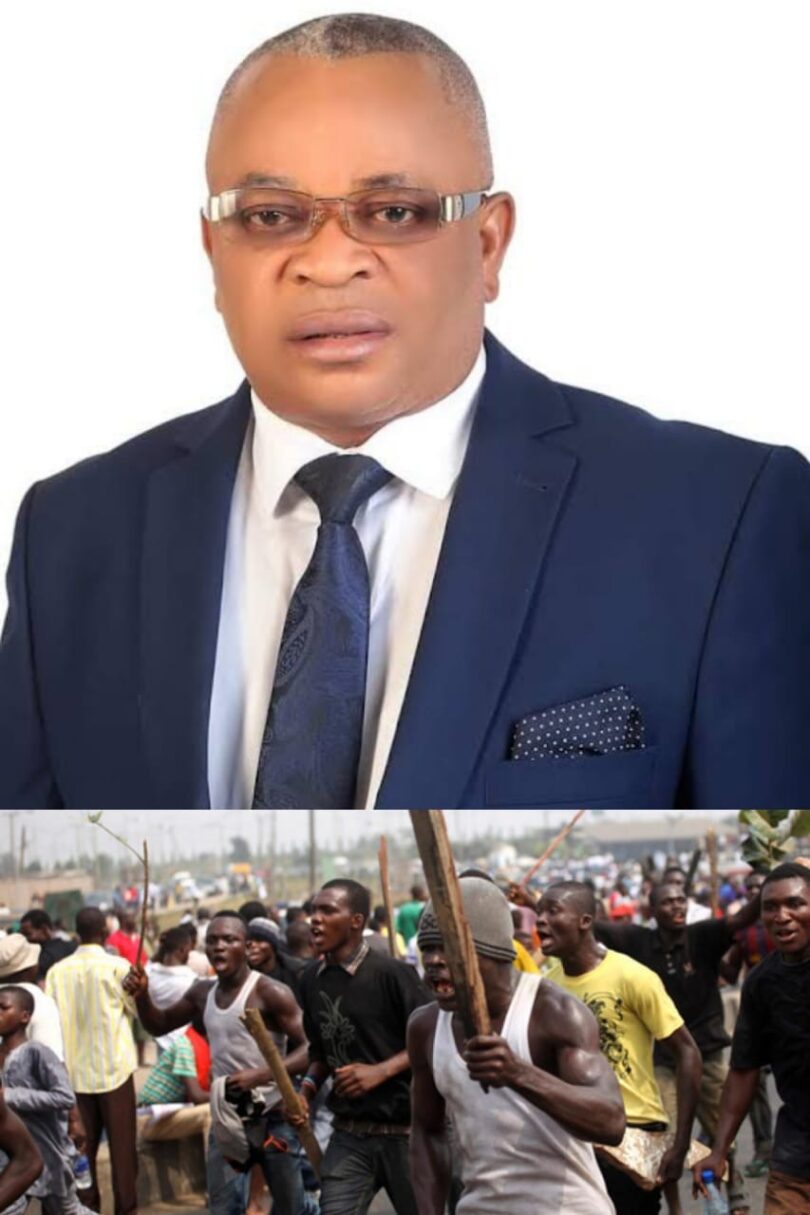

Towards a Peaceful Resolution of the Boje/Isobendeghe Crisis: Lessons from the Katchuan-Edum Crisis of 1983–1986
By Associate Prof. Jake Otu Enyia
SSA, Political Affairs | Proud Son of Boki | Calabar
Evil has no place in society when good people speak against its existence. When good people choose brotherhood over hatred, unity over division, neutrality over bias, and light over darkness, evil can be eliminated.
No meaningful development can take place in an atmosphere of hostility, fear and destruction. This is why the current crisis between Boje and Isobendeghe communities in Boki Local Government Area of Cross River State requires urgent, sincere and collective intervention.
One useful example that can guide the search for peace is the Katchuan Irruan–Edum-Mbube crisis of 1983 and 1986, where community leaders and stakeholders demonstrated that dialogue, local ownership and evidence-based reconciliation can restore lasting peace.
The Katchuan Irruan–Edum-Mbube Experience
In 1986, Katchuan Irruan in Boki LGA and neighbouring Edum-Mbube in Ogoja LGA became embroiled in a serious conflict.
What initially appeared to be a minor disagreement eventually escalated into a full-scale confrontation, resulting in the destruction of lives and property and the use of sophisticated firearms and ammunition.
In response to the devastating consequences of the conflict, elites from both communities came together and formed a formidable peace committee with the objective of finding a solution without external interference.
The committee met periodically, alternating its meeting venues between the two communities.
As part of its efforts, the committee co-opted Catholic priests, including Rev. Fr. Michael Obi of St. Columba Parish, Edum-Mbube, and Rev. Fr. Paul Owan Bisong of St. Mary Catholic Church, Katchuan Irruan, as well as traditional chiefs from both communities who possessed extensive knowledge of the disputed land.
The priests and other members of the committee undertook a rigorous three-day inspection of the disputed areas, covering locations from Katchuan Irruan Secondary School to Okubushu.
At the conclusion of the inspection, the peace committee met in Katchuan Irruan and took decisions based on evidence gathered during the exercise. The committee subsequently met in Edum-Mbube to review and reconcile the agreements reached at Katchuan.
After reaching a compromise, the boundaries were clearly demarcated, with live sticks planted to indicate the agreed positions.
The agreements were subsequently documented in a Memorandum of Understanding (MoU) to serve as a reference document going forward.
The document was endorsed by the 20-member committee that championed the reconciliation process before being presented to the parties involved as a working document in 1987.
Copies were also forwarded to the Surveyor-General of the state and the then Governor of Cross River State, Sen. Liyel Imoke, with a request for permanent boundary beacons to be established.
The approach helped restore peace between the communities, demonstrating the effectiveness of community-led dialogue, fact-finding and negotiated settlement.
The Peace Pathfinders
The stakeholders from Edum-Mbube who played significant roles in the peace process included:
- Sir Abang Anok
- Chief Francis Bulem
- Dr. Ojikpong
- Late Barr. Oroyi Inyang
- Chief Paddy Agbe
- Engr. David Sunday Ukwanlity
From the Katchuan Irruan side were:
- Chief Barr. Patrick Odu
- Chief Prof. Jake Otu Enyia
- Capt. Eddy Ndom
- Capt. Patrick Kekong
- Mr. Phillip Abua Enyia
- Hon. Bishop Sunday Tiku
- Mr. Sunday Okwashi
Their efforts offer an important lesson for the present generation: peace is possible when community leaders put the collective interest above division and commit themselves to dialogue.
Boje and Isobendeghe: A Shared Heritage
Fast-forward to the present realities.
Boje and Isobendeghe are both Boki communities, sharing the same political ward, intertwined ancestry and similar cultural values, celebrations and traditions.
The two communities have historically practised intermarriage and shared schools, markets, roads and other social institutions. Ordinarily, these connections should strengthen their bonds and reinforce their sense of brotherhood.
Sadly, these common bonds have increasingly been overshadowed by hostility and bloodshed.
The shared humanity of the communities is being undermined by the loss of young lives. Children are being left without parents, while pregnant and nursing mothers face the devastating consequences of losing their breadwinners.
This situation cannot continue.
A Call for Boki Leaders to Act
To change this narrative, all hands must be on deck, just as the elites of Katchuan Irruan and Edum-Mbube did in the 1980s.
Prominent sons and daughters of Isobendeghe, including His Excellency Amb. Soni Obache Abang, Pascal Kejie, Sylvester Abang, Clifford Bubua, Evang. Alfred Odok, Dr. Cassidy, Augustine Kachua, Barr. Fidelis Dibang, Barr. J.A. Dakim and Pius Abang, among others, must redouble their efforts towards urgently addressing the crisis.
On the Boje side, leaders and stakeholders including Dr. Pius Tawo, Rt. Hon. Dr. Alex Ebu, Chief Engr. Kelvin Njong and Dr. Barr. Cleverty Afu should also take the lead in the peace process.
Other stakeholders who should be co-opted include Barr. Attah Ochinke, Rt. Hon. Soni Eta, Hon. Victor Abang, Barr. O.N. Agbor, Hon. Bette Phillip Obi, President-General of Otchebe Boki Chief John Owan, as well as Rev. Fr. Chris Owan, Rev. Fr. Ferdinand Omah, Rev. Fr. Mike Obi, Rev. Fr. Santos Achu, AIG John Abang, community chairmen, women leaders, youth leaders and other illustrious sons and daughters of Boki.
These stakeholders must rise to the occasion and work collectively to tame the ugly tide of violence.
Peace is priceless. It must be pursued, protected and sustained with determination.
Recommendations for Lasting Peace
To facilitate a peaceful resolution and prevent further escalation, the following measures are proposed:
- Government should consider acquiring the disputed land and establish a permanent security presence, including Army and Mobile Police units, to de-escalate tension and protect rural residents.
- The Nkarasi–Isoben–Onitcha Farm Road should be opened and rehabilitated to improve accessibility and facilitate rapid security and emergency response.
- Government should intensify efforts to recover illegal arms and ammunition and prevent further proliferation in the affected communities.
- The Boki Local Government Council should enact a by-law prohibiting inter-community warfare and prescribing appropriate sanctions for acts capable of triggering communal violence.
- The Police Headquarters at Boje should be made fully functional and adequately equipped to respond effectively to security threats and potential uprisings.
- The Local Government Chairman should constitute and adequately fund an independent Peace, Reconciliation and Reunion Committee comprising credible representatives of the affected communities.
- Boki youths should desist from inflammatory and negative reporting of the crisis on social media, particularly content capable of escalating tensions.
- The State Government should consider establishing low-cost housing for Boki Local Government staff at Onitcha Farm to encourage habitation and development in the area.
- Political party leaders should harmonise their efforts and support an all-purpose campaign against civil unrest in Boki.
- Religious leaders should designate a day for a solemn assembly at Onitcha Farm to pray and recommit Boki to peace and peaceful coexistence.
- The Paramount Ruler and Boki Traditional Rulers Council should visit the affected Boje and Isobendeghe communities and directly engage residents on the need for peaceful coexistence.
- Youth organisations should intensify sensitisation campaigns on the dangers and consequences of communal conflict.
- The Local Government Council should open up the major road linking Boje to Borum and the Boje–Kakkubok route to improve movement and security response.
- The roadblocks at Bansan and Nsadop should be discontinued to facilitate movement and reduce further tension.
A Collective Responsibility
The crisis between Boje and Isobendeghe should not be allowed to define the future of Boki.
The experience of Katchuan Irruan and Edum-Mbube demonstrates that even communities that have experienced serious conflict can find common ground when credible leaders choose dialogue over confrontation and reconciliation over revenge.
Boki’s rich cultural heritage, economic potential and shared identity deserve protection.
The responsibility for restoring peace does not rest solely with government. Traditional rulers, political leaders, religious institutions, community leaders, women, youths, civil society organisations and other stakeholders all have a role to play.
With genuine commitment, courageous leadership and sustained dialogue, peace can return to Boje and Isobendeghe and create an environment conducive to the socioeconomic and political development of Boki.
Peace must be the priority. Boki deserves nothing less.
Hope you find the Above publication useful, Calabargist will love to keep you updated via our newsletter by subscribing with your email.