
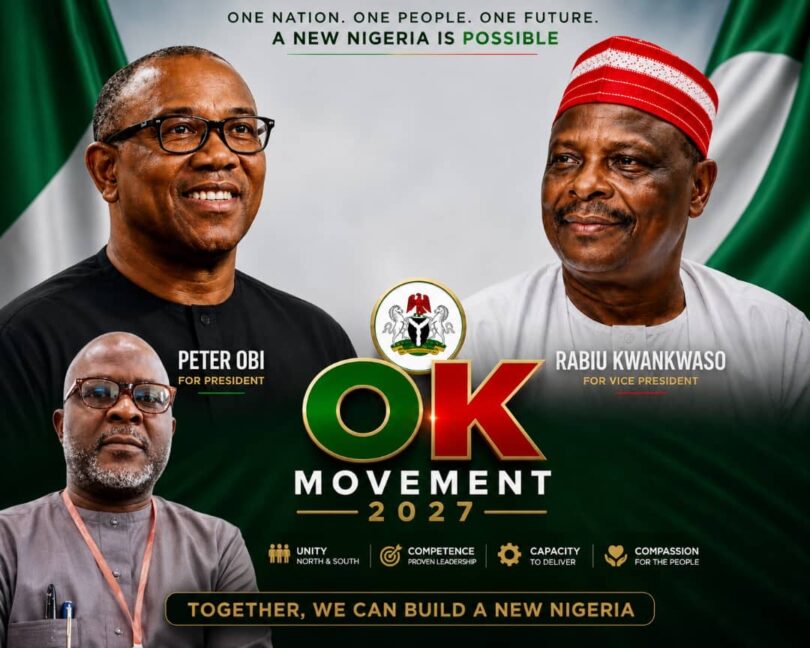

Why Nigerians Are Looking To Obi–Kwankwaso As A Viable Alternative For National Rebirth In 2027
✓ NDC Presents a Vision of Competence, Production-Driven Growth, Security Reform and Responsible Governance
By Comrade Cletus Albert Amawu
State Publicity Secretary, Nigeria Democracy Congress (NDC), Cross River State
Zonal Spokesperson, OKMovement South-South
As Nigeria approaches another defining electoral cycle, millions of citizens are increasingly confronted with a fundamental question: should the nation continue along the path that has produced widespread economic hardship, rising insecurity, unemployment and declining public confidence, or should it embrace a new direction founded on competence, accountability and measurable results?
Across the country, conversations in homes, markets, universities, workplaces and places of worship are converging on the need for transformational leadership capable of restoring hope and rebuilding the Nigerian state. It is within this context that the prospect of the joint ticket involving Peter Obi and Rabiu Musa Kwankwaso under the platform of the Nigeria Democracy Congress has generated significant interest among Nigerians seeking genuine change.
The attraction is not merely based on political rhetoric. Rather, it is rooted in demonstrable records of public service, prudent management of resources and verifiable developmental achievements during their respective tenures as governors.
A Record of Performance Rather Than Promises
For many Nigerians, leadership should be assessed not by eloquent speeches based on lies, but by tangible accomplishments.
During his tenure in Anambra State, Peter Obi became widely recognised for fiscal discipline, strategic investments in education, healthcare and infrastructure, and prudent management of public finances. His administration consistently emphasised value for money, accountability and long-term planning.
And similarly, Rabiu Musa Kwankwaso left an enduring footprint in Kano State through extensive investments in education, healthcare infrastructure, road construction, rural development and human capital advancement. His administration’s emphasis on empowering young people through educational opportunities remains one of the defining aspects of his legacy.
Together, both men represent a blend of administrative experience, economic understanding and grassroots appeal that many Nigerians believe could reposition the nation.
Tackling Insecurity Head-On
No nation can prosper where insecurity thrives.
Today, Nigerians continue to grapple with terrorism, banditry, kidnapping, communal conflicts and other violent crimes that have undermined national stability and economic productivity.
An Obi–Kwankwaso administration under the NDC would be expected to prioritise comprehensive security sector reforms, strengthen intelligence gathering, improve inter-agency coordination and deploy technology-driven security solutions.
Beyond military responses, the administration would focus on addressing the underlying causes of insecurity, including poverty, unemployment, social exclusion and lack of opportunities for young people.
Security must not merely be about responding to crises; it must be about preventing them.
From Consumption to Production
One of Nigeria’s greatest challenges is the overdependence on consumption rather than production.
For decades, the country has imported goods that could be produced locally, thereby exporting jobs and weakening domestic industries.
The NDC believes Nigeria must transition from a consumption-driven economy to a production-oriented economy powered by agriculture, manufacturing, technology, innovation and industrialisation.
An Obi–Kwankwaso government would prioritise:
•Agricultural modernisation and food security.
•Support for small and medium-scale enterprises.
•Expansion of local manufacturing.
•Youth entrepreneurship programmes.
•Technology and innovation hubs.
•Export-oriented economic policies.
•Industrial growth corridors across the six geopolitical zones.
Such policies would not only create employment but also strengthen the naira and reduce dependence on imports.
Confronting the Hydra of Corruption
Corruption remains one of the greatest impediments to Nigeria’s development.
Public resources meant for infrastructure, healthcare, education and social services are too often diverted through leakages and abuse of office.
The NDC maintains that corruption must be confronted through transparent governance systems, strengthened institutions, digital public procurement processes, effective oversight mechanisms and strict enforcement of accountability standards.
The objective is not merely to punish wrongdoing but to build systems that make corruption increasingly difficult to perpetrate.
Nigeria cannot achieve meaningful development while public resources continue to serve private interests.
Reducing the Cost of Governance
Another critical pillar of the NDC vision is the reduction of the cost of governance.
At a time when millions of Nigerians are struggling with economic hardship, the government must demonstrate fiscal responsibility and prudent management of public funds.
An Obi–Kwankwaso administration would pursue policies aimed at:
•Eliminating wasteful expenditure.
•Rationalising overlapping government agencies.
•Reducing unnecessary political appointments.
•Strengthening budgetary discipline.
•Enhancing transparency in public spending.
The goal would be to significantly reduce recurrent expenditure and channel more resources towards infrastructure, healthcare, education, agriculture and job creation.
The government must become leaner, more efficient and more responsive to the needs of citizens.
A New Social Contract
The growing appeal of an Obi–Kwankwaso partnership reflects a broader yearning among Nigerians for leadership that inspires confidence and delivers results.
Citizens are increasingly demanding leaders whose records can be independently verified, whose actions reflect integrity and whose policies address the practical realities facing ordinary Nigerians.
The NDC believes that the future of Nigeria lies not in ethnic, religious or regional considerations, but in competence, character and capacity.
The task before Nigerians is therefore not merely to elect leaders but to choose a pathway towards national renewal, economic prosperity, security and social justice.
As the nation moves closer to 2027, the conversation must shift from empty promises to proven performance, from political slogans to measurable outcomes, and from personal ambition to national interest.
Nigeria deserves leadership that works.
Nigeria deserves governance that delivers.
Nigeria deserves a future built on productivity, accountability and shared prosperity.
The Nigeria Democracy Congress remains committed to providing that alternative and building a nation that works for all Nigerians.
Hope you find the Above publication useful, Calabargist will love to keep you updated via our newsletter by subscribing with your email.