
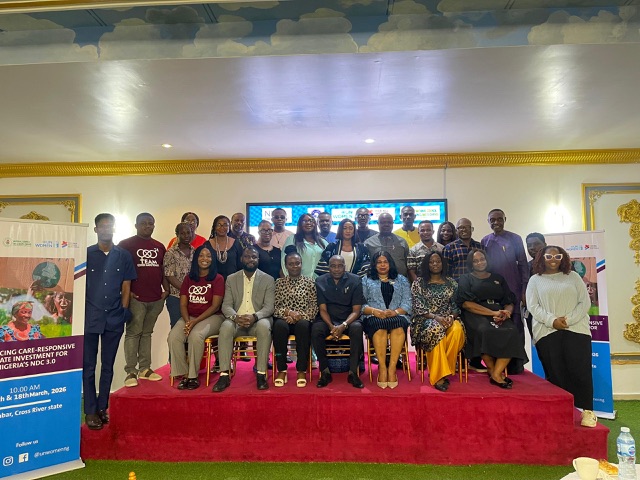

In a bold step toward advancing inclusive and sustainable development, the Department of Gender Mainstreaming, with the support of UN Women, the National Council on Climate Change, and the NDC Partnership, convened a high-level stakeholders’ roundtable with climate investors on Care and Climate.
This landmark engagement brought together policymakers, development partners, technical experts, and investors to explore how integrating *care systems into climate action* can unlock innovative, people-centered solutions for resilience and growth in Cross River State.
Why Care and Climate Matter Together
Climate change is not gender-neutral. Its impacts are felt most by women especially those in vulnerable and rural communities who also shoulder a disproportionate share of unpaid care work. At the same time, care systems remain underfunded and undervalued, despite their critical role in sustaining households, economies, and communities.
The roundtable reinforced a clear message: *investing in care is investing in climate resilience*. When care systems are strengthened and powered through sustainable solutions, they become a vital pathway for both adaptation and mitigation.
Innovative Solutions from the Technical Working Group on Care
A major highlight of the engagement was the presentation by the Technical Working Group (TWG) on Care, which showcased practical, scalable innovations that connect care delivery with climate action:
Solar-powered crèches to support working families while providing clean, reliable energy for childcare services
Electric and CNG-powered motorbikes and tricycles, with a strong emphasis on tricycles adapted for healthcare delivery and emergency response in underserved communities
Waste-to-biogas solutions* that convert organic waste into clean cooking energy for households and care institutions
These solutions demonstrate that care infrastructure can be reimagined as green, efficient, and community-centered systems that reduce emissions, create jobs, and improve quality of life.
What This Means for Cross River State
This high-level engagement positions Cross River State at the forefront of gender-responsive climate innovation. By aligning care systems with climate priorities, the state is opening new pathways to:
* Attract and leverage climate finance for inclusive development
* Strengthen policies that integrate care into climate adaptation and mitigation strategies
* Build resilient communities where women and vulnerable groups are not just beneficiaries, but active drivers of solutions
The Department of Gender Mainstreaming, under the leadership of the Special Assistant on Gender Mainstreaming, continues to demonstrate visionary leadership—bridging global frameworks with local realities and ensuring that climate action leaves no one behind.
The Road Ahead
The roundtable marks the beginning of a strategic journey toward implementation and scale. Key next steps include:
* Deepening partnerships with climate investors and development partners
* Developing policy and financing frameworks that embed care into climate strategies
* Scaling pilot innovations across communities in Cross River State
As momentum builds, one thing is clear: Cross River State is redefining climate action by placing care at its center proving that sustainable development is strongest when it is inclusive, innovative, and people-driven.