
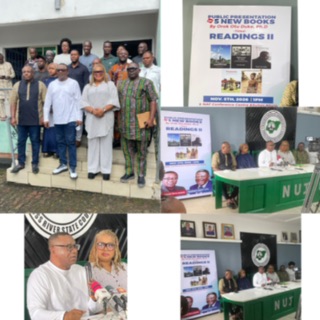

Renowned media practitioner and author, Orok Otu Duke, Ph.D., has announced plans to present five books in Abuja on the 5th, featuring historical accounts, family experiences, contemporary Calabar stories and poetry.
Speaking during an engagement with members of the media, Duke explained that the publications were inspired by his personal experiences, historical events and the need to preserve the stories of Cross River State and its people for future generations.
The collection comprises three prose books and two poetry collections, covering the Nigerian Civil War, family history, contemporary life in Calabar and poetic reflections on people and society.
Duke said his decision to document these experiences was driven by the conviction that communities must tell their own stories rather than allow others to define their histories.
Welcome to Uyo Documents Nigerian Civil War Experiences
Among the five publications, Duke identified Welcome to Uyo: The Nigerian Civil War Through the Eyes of the Calabar Child, 1967–1970 as his magnum opus for now.
He explained that the book draws from his childhood experiences during the Nigerian Civil War, when Uyo served as an important refuge and relief centre for displaced people in the former South-Eastern region.
According to him, his family lived through the period when his mother worked as a teacher and his father was employed by the railway service. His mother’s posting to Uyo exposed him to the difficult realities faced by refugees and civilians during the conflict.
Duke recalled witnessing widespread suffering, deaths and the loss of classmates and other people around him.
He said the experiences left lasting impressions on him and motivated him to document what he witnessed as a child.
The author noted that the book also reflects the experiences of his family and other children who lived through the conflict, preserving personal memories that might otherwise be lost with time.
He explained that the book cover features a family photograph from that period, allowing readers familiar with his background to identify him among the children pictured.
Family History, Calabar Stories Feature in Book Collection
Another publication, Three Generations of the Okerekes in Calabar, Before, During and After the Civil War, explores family history across different periods of Calabar’s development and the Nigerian Civil War.
The book contributes to the broader effort to preserve family narratives and document how historical events shaped individuals, households and communities.
Duke also highlighted Welcome to Calabar, which explores contemporary stories and experiences in Calabar and its surrounding communities.
He said the publication moves beyond familiar historical narratives to include modern accounts and stories about people and developments in the area.
The two poetry collections complete the five-book series. According to Duke, the works contain poems, tributes and reflections that document personal experiences, societal issues and the stories of people within the community.
He said the publications were intended to present different dimensions of Cross River’s history and contemporary identity through prose and poetry.
Ruben Abati, Professors Expected to Review Publications
Duke disclosed that several academics and media personalities had indicated interest in reviewing the books ahead of their public presentation in Abuja.
Among those mentioned was journalist and former presidential spokesperson, Reuben Abati, whom Duke said was his university classmate and had expressed willingness to review one of the publications.
He also referred to academics from the University of Uyo and other institutions who were expected to contribute reviews.
The author said the involvement of reviewers would provide opportunities for scholarly engagement, public discussion and broader appreciation of the books’ historical and cultural significance.
He invited members of the media, academics, writers and other interested individuals to attend the presentation and contribute to conversations surrounding the publications.
Duke Urges Cross Riverians to Document Their Own Stories
A central message in Duke’s address was the importance of indigenous storytelling and historical documentation.
He argued that communities should not depend exclusively on outsiders to record their experiences, noting that accounts of historical events may be incomplete or distorted when the people directly affected do not document their own perspectives.
Using the familiar metaphor that the story of the hunt will glorify the hunter until the lion tells its own story, Duke encouraged Cross Riverians to write about their personal experiences, families, communities and institutions.
He said documentation should not be limited to periods of success or celebration but should also include difficult experiences, struggles and painful chapters of history.
The author called on professional associations, particularly the Nigeria Union of Journalists (NUJ), Cross River State Council, to encourage members to contribute articles and collective publications documenting the state’s media history and the experiences of its practitioners.
He suggested that groups could collaborate to produce books chronicling their activities, contributions and historical development, thereby creating a lasting record for future generations.
According to him, publishing and preserving such accounts would help communities maintain their identity and ensure that their experiences remain accessible to researchers, students and the general public.
Author Reflects on Academic Journey and Media Career
Duke also spoke about his academic journey, explaining that his decision to pursue a Ph.D. later in life was partly motivated by a desire to encourage others not to abandon their educational ambitions.
He recalled completing his master’s degree in December 1991 before eventually pursuing his doctoral qualification, which he said had been a long-standing aspiration since 1998.
He described completing major personal and professional goals as an example for others who might be hesitant to begin or finish their own projects.
Reflecting on his media career, Duke recalled his involvement in the development of broadcasting infrastructure in Cross River State, including work connected with Cross River Television during his tenure in the state’s information and culture administration from October 1994 to 1996.
He said his experiences across media, public service and historical documentation had reinforced his belief in the importance of preserving knowledge and completing projects that can benefit others.
Duke disclosed that he had several additional manuscripts awaiting publication and expressed hope that the forthcoming presentation would encourage more people to document their experiences.
Duke Pays Tribute to Late Anetie Benakban
During the engagement, Duke also expressed condolences over the passing of Anetie Benakban.
He used the occasion to acknowledge the contributions of colleagues and others who had participated in professional and public life, emphasising the importance of recognising people’s efforts while they are still alive.
He encouraged professional communities to preserve the experiences of their members through publications and other forms of historical documentation.
Public Presentation Scheduled for Abuja
Duke formally invited journalists, academics, writers, historians and members of the public to attend the presentation of the five books in Abuja on the 5th.
He said the event would provide an opportunity to introduce the publications to a wider audience, discuss their themes and encourage further contributions to the documentation of Cross River history and Nigerian experiences.
The author expressed hope that the books would inspire other people to write, preserve family histories and contribute to the documentation of their communities.
For Duke, the project goes beyond publishing books. It is an appeal for individuals and institutions to preserve their experiences, contribute to collective memory and ensure that future generations have access to the stories that shaped their communities.
Editorial note: The exact month, year, venue and time of the Abuja presentation were not specified in the supplied remarks. These details, along with the official titles of all five books and the spelling of names, should be confirmed before publication.
Hope you find the Above publication useful, Calabargist will love to keep you updated via our newsletter by subscribing with your email.