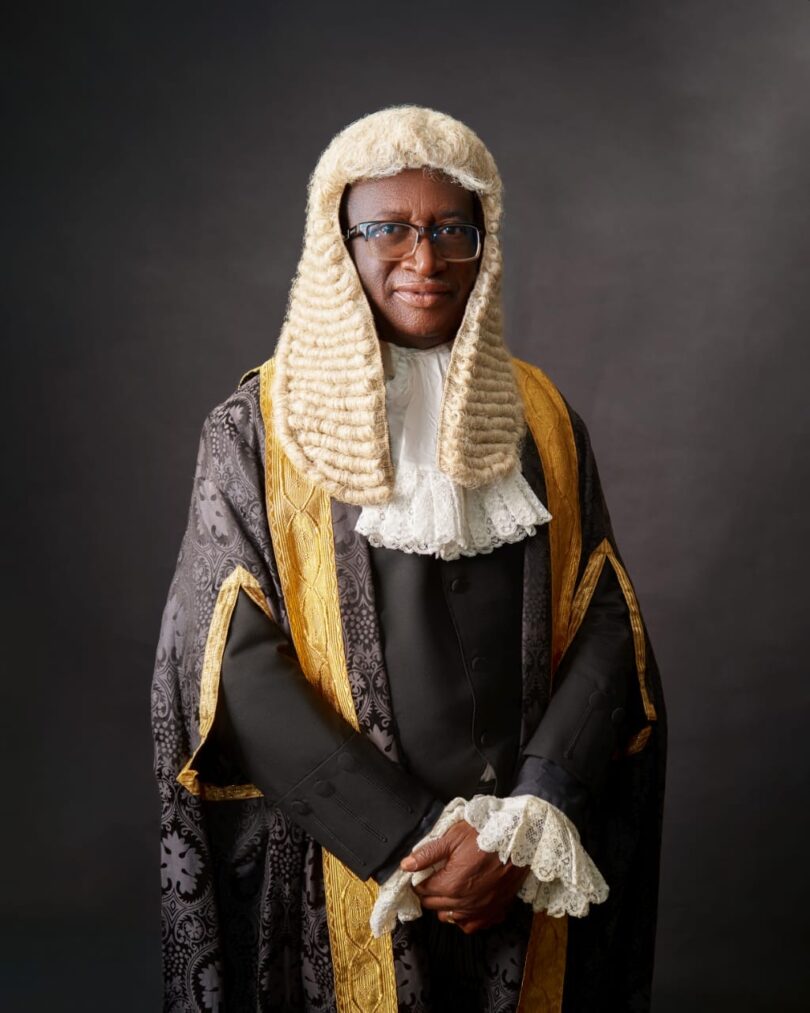

Sen. Victor Ndoma-Egba at 70: A Life of Law, Leadership and Legislative Influence
By Rasheed Olanrewaju
In the evolution of Nigeria’s democratic experience, certain public figures stand out not merely for the offices they have occupied, but for the institutional value they have added and the leadership stability they have provided across changing political eras.
One of such figures is Distinguished Senator Victor Ndoma-Egba, SAN, OFR, CON, whose career reflects a rare blend of legal scholarship, legislative depth, administrative experience, and mentorship-driven influence.
As he marks his 70th birthday, the occasion offers an important moment to reflect on a public life defined by professionalism, discipline, and sustained national relevance.
His journey reinforces the timeless observation by John C. Maxwell that “Leadership is not about titles, positions or flowcharts.
It is about one life influencing another.”
Over the decades, Ndoma-Egba’s career has consistently demonstrated how professional credibility can translate into institutional impact.
Born on March 8, 1956, in Ikom, Cross River State, Ndoma-Egba’s early exposure to education and discipline laid the foundation for a career that would later shape legal practice and legislative governance in Nigeria.
He studied law at the University of Lagos and the University of Calabar at the post graduate level, building a strong academic and professional background that culminated in his elevation to the prestigious rank of Senior Advocate of Nigeria (SAN), one of the highest distinctions in the Nigerian legal profession.
Before entering partisan politics, he had already earned recognition within the legal community through active involvement in the Nigerian Bar Association, demonstrating early commitment to institutional growth and professional ethics.
His transition into public service therefore reflected a natural progression rather than an abrupt political ambition.
As observed by Peter Drucker, “Management is doing things right; leadership is doing the right things.” This distinction has remained evident throughout his career.
Ndoma-Egba’s political relevance became firmly established when he was elected Senator representing Cross River Central Senatorial District, serving three consecutive terms between 2003 and 2015 in the Nigerian Senate.
Within this period, he rose to the strategic position of Senate Leader, one of the most influential roles in Nigeria’s legislative structure.
His tenure in the Senate was marked by active engagement in legal reforms, petroleum sector debates, and legislative strengthening of democratic institutions.
During his three consecutive terms, he played a strategic role in shaping key national legislation through strong procedural leadership and legal expertise.
As Senate Leader, he coordinated deliberations on major reforms, including electoral amendments that strengthened Nigeria’s democratic framework and extensive debates on petroleum sector restructuring.
During his tenure as Senate Leader, the Senate also introduced the doctrine of necessity to stabilize the country and protected legislative independence in exercising the constitutional principle of separation of powers between the executive and legislative arms of government.
His legal background as a Senior Advocate of Nigeria gave depth to his contributions, particularly in constitutional interpretation and institutional reforms that enhanced legislative clarity and governance accountability.
Ndoma-Egba also played an important leadership role in guiding the legislative process that led to the passage of the Freedom of Information Bill into law.
Through consensus-building, floor coordination, and bipartisan engagement, he helped facilitate progress on the landmark transparency legislation alongside other governance-focused reforms and oversight initiatives, including legislative backing for development interventions in the Niger Delta region.
His tenure reinforced the principle that enduring legislative impact is often driven not only by sponsorship, but by strategic leadership and institutional discipline.
Currently a chieftain of the ruling All Progressives Congress, his political evolution mirrors Nigeria’s democratic transitions, yet his reputation has remained rooted in legislative competence rather than partisan theatrics.
In the words of Nelson Mandela, “A good head and a good heart are always a formidable combination.”
Following his Senate career, Ndoma-Egba’s appointment as Chairman of the Niger Delta Development Commission by the administration of Muhammadu Buhari expanded his public service responsibilities into the complex realities of regional development.
Managing infrastructure expectations, stakeholder interests, and institutional reforms required diplomatic capacity and administrative discipline cultivated over decades of public engagement across the nine states of the oil-rich region.
His continued relevance in national assignments has been further reinforced through strategic governance responsibilities under the current administration of Bola Ahmed Tinubu, reflecting sustained confidence in his experience and institutional memory.
This trajectory aligns with the insight of Winston Churchill that “The price of greatness is responsibility.”
He was elevated to the prestigious rank of Senior Advocate of Nigeria (SAN) by the Senate of the Federal Republic of Nigeria- the first and only legislator so honoured at the time.
Ndoma-Egba served as Leader of Nigeria’s delegation to ASSECAA (Association of Senates, Shooras and Equivalent Councils in Africa and the Arab World) during its session in Sanaa, Yemen.
As a member and later Leader of Nigeria’s delegation to the Pan-African Parliament in Midrand, South Africa, Senator Ndoma-Egba also served as President of the First Africa Legislative Summit which brought together 54 Heads of Parliaments from Africa and the Pacific in Abuja in November 2013.
He was appointed Special Envoy by former President Goodluck Jonathan for the successful election of Bethel Amadi as President of the Pan-African Parliament.
Beyond public offices, Senator Ndoma-Egba’s influence is strongly reflected in mentorship and political development across Cross River State and beyond, where several emerging leaders have grown within structures shaped during his era of legislative leadership.
Yet, what distinguishes him further is not only public influence but personal discipline, calm, methodical, time-conscious, and spiritually grounded.
Aside his public life, Senator Ndoma-Egba is widely respected as a devoted family man.
Known for his calm demeanor and disciplined approach, he balances the demands of politics and public service with a deep commitment to his loved ones.
He prioritizes family values, nurturing strong bonds with his children and supporting his wife (now late) in both personal and professional endeavors.
Ndoma-Egba’s home is often described as a space of warmth, guidance, and mentorship, reflecting the same principles of integrity, responsibility, and care that have defined his public life.
A devoted Catholic, he observes his prayer commitments with consistency regardless of schedule, reflecting the philosophical thought of Aristotle that “We are what we repeatedly do. Excellence, then, is not an act, but a habit.”
Away from governance responsibilities, tennis remains his preferred recreational activity, an enduring habit that mirrors his belief in balance between physical wellness and intellectual clarity.
On a personal note, my relationship with Senator Ndoma-Egba dates back to 2007 when I began interacting with him as a journalist in Cross River State and later officially covering his activities from 2008.
Over time, that professional interaction grew into a fatherly relationship built on trust, guidance, and shared national conversations.
Leadership lessons often came not through formal speeches but through simple discussions at his homes in Abuja, Calabar, and Ikom, where access was never restricted by hierarchy.
This bond made it both natural and deeply honouring when he accepted to serve as Chairman at my wedding ceremony on September 18, 2021 in Calabar.
At that event, attended by the then sitting Governor, Prof. Ben Ayade and his deputy, Prof. Ivara Esu,Obong of Calabar, Emirs alongside other top dignitaries across Nigeria.
Other dignitaries present were also the Governor of Kwara State, Mallam AbdulRahman AbdulRazaq.”
represented by his deputy, Chief Kayode Alabi, he humorously remarked that Cross River State had permanently adopted me, joking that the people of Ilorin and Kwara State had “lost Rasheed to Cross River.”
His affectionate title for me, Otunba- remains one of the personal honours I cherish deeply whenever we speak or meet.
Over the years, I have also observed his unwavering support for journalism, particularly through his longstanding relationship with the Nigeria Union of Journalists in Cross River State, where he has provided professional encouragement, moral support, and periodic assistance spanning over three decades.
His respect for the media reinforces the statement by Thomas Jefferson that “Our liberty depends on the freedom of the press.”
Even as a politician, Senator Victor Ndoma-Egba is not known for keeping a large circle of friends.
However, among the few he holds in very high regard is Chief Bayo Ojo, SAN, (Former Minister of Justice and Attorney General of the Federation) he often describes (whenever I am with him) as both a trusted ally, personal friend and colleague.
At seventy, Senator Victor Ndoma-Egba represents a generation of Nigerian leaders whose public influence grew from professional credibility before political prominence.
His journey demonstrates that the intersection of law, governance, and mentorship can produce enduring institutional value.
His life equally validates the words of Martin Luther King Jr. that “Life’s most persistent and urgent question is: What are you doing for others?”
Seventy therefore stands not just as a celebration of age, but as a testament to discipline, service, and enduring relevance.
In a time when Nigeria continues to seek leadership anchored on experience and integrity, his career remains a reference point that professionalism and public service can indeed intersect productively.
Rasheed Olanrewaju Zubair, ANIPR, FMBI, a senior journalist, Media Consultant and public relations expert, writes from Abuja.